
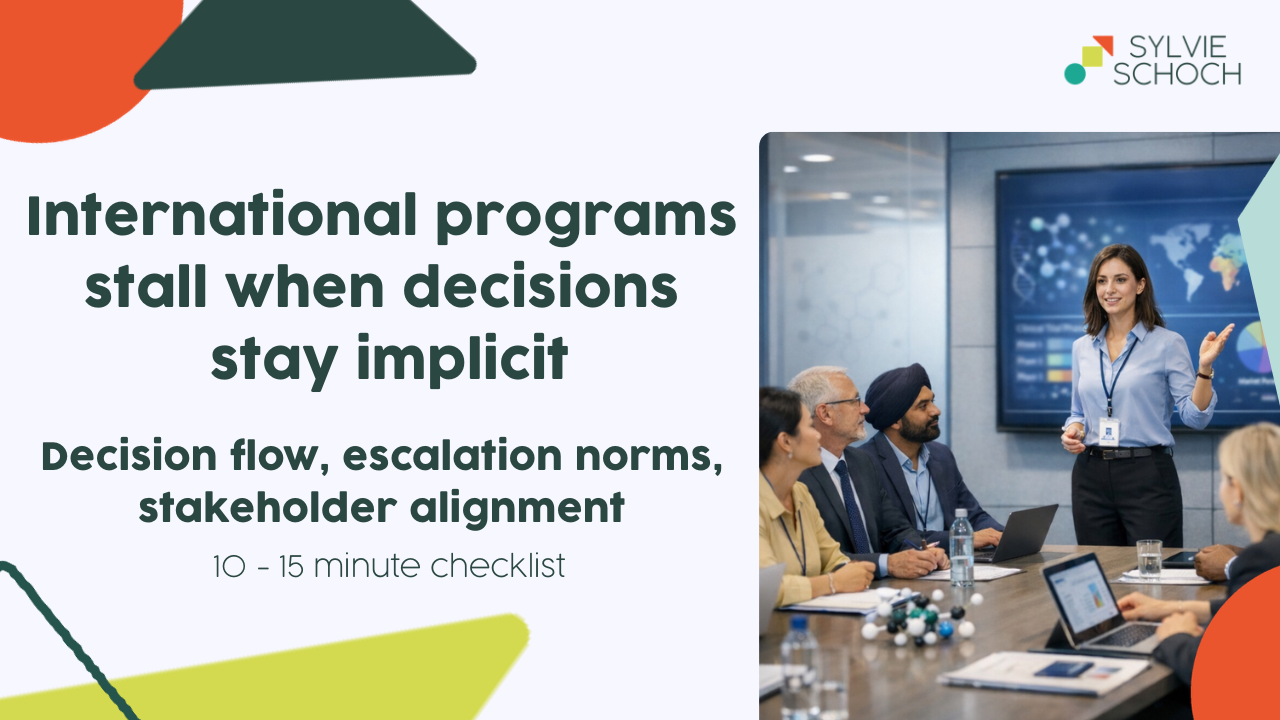
Why multi-country programs stall on the people-layer: decision flow, escalation norms, stakeholder alignment
International programs rarely fail because the strategy is wrong. They stall because the program runs on invisible assumptions, how decisions get made, what alignment means, how escalation works, and who needs to be involved before a decision is considered real.
For executives leading multi-country programs, the people-layer often determines speed and outcomes more than the plan, because stakeholder reality, decision flow, and escalation norms are interpreted differently across countries and functions.
Within a single country, these assumptions stay hidden. In multi-country, multi-stakeholder programs, they turn into friction, and friction turns into delay.
This article is not about collecting cultural facts. It is about designing the people-layer so your program can move, stakeholder reality, decision flow, escalation norms, and a communication cadence that holds under pressure.
The executive reality, one program, many interpretations
Across countries, the same words can mean different things.
- “Yes” can mean yes, yes but later, yes if my manager agrees, yes to the relationship, or simply I heard you.
- “Escalate” can mean raise an issue early, or avoid escalation until it’s unavoidable.
- “Aligned” can mean informed, consulted, or fully bought in.
If you don’t design for these differences, predictable symptoms follow.
- Long meetings with unclear outcomes
- Decisions that sound agreed in the call, then dissolve afterward
- Stakeholder surprises, “I didn’t know this was decided”
- Escalations that happen too late, or too blunt
- Local teams protecting themselves instead of collaborating
This is not a culture issue. This is a program architecture issue.
A leadership lens, the 3-layer competence model
Use this as a fast diagnostic. Most international programs overinvest in Layer 1 and under-design Layers 2 and 3.
Layer 1, Specific, content and expertise
Scope, deliverables, timeline, dependencies, quality, budget. Necessary, not sufficient.
Layer 2, Individual, how leaders and experts show up
Comfort with ambiguity, relationship to hierarchy, confidence to raise risk, response to conflict, need for clarity, risk posture.
Layer 3, Social, how the system coordinates
Decision rights, escalation routes, influence networks, meeting choreography, written versus verbal alignment, and the real yes.
Most international program slowdowns happen in Layer 3.
“Pack the suitcase” for international programs
For programs, “pack the suitcase” becomes three design moves, stakeholders, decision architecture, cadence.
1) Stakeholder map, the real one
Org charts are not enough. You need to see:
- Formal decision owners
- Informal influencers
- Silent blockers
- Sponsors who can remove constraints
- Cross-country dependencies and local constraints
One question prevents invisible rework: Who needs to feel consulted before a decision is real?
2) Decision architecture, how decisions actually move
International programs need explicit answers to:
- What decisions are local versus global?
- What requires consultation versus approval?
- What counts as a decision, a meeting statement, a written note, a signature, a ticket status?
- What is the escalation path, and what is the early warning signal?
If governance assumes one decision approach is universal, the program will create alignment on paper and resistance in practice.
3) Communication cadence, coordination without meeting overload
Executives don’t need more meetings. They need a rhythm that reduces ambiguity.
A strong cadence typically includes:
- A short cross-country steering touchpoint, decision oriented
- A working level delivery check in, dependencies and risks
- A written update rhythm, so alignment survives time zones
- A clear escalation mechanism, so issues travel quickly without political damage
The goal is not communication. The goal is coordination under complexity.
What strong international program leaders do differently
They shape the conditions so alignment and decisions are visible and durable.
- They make stakeholder reality explicit rather than relying on local assumptions.
- They clarify decision rights and escalation norms so yes becomes operational.
- They design a cadence that prevents surprises and reduces ambiguity.
- They treat agreement as a signal to validate, not a guarantee.
This is not about controlling people. It’s about reducing waste, fewer loops, fewer misunderstandings, fewer late escalations, fewer decisions that need to be redone.
Download the International Program Alignment Worksheet, 10 to 15 minutes
Apply this before your next key steering call or cross-country alignment moment.
Use the International Program Alignment Worksheet to map stakeholders, clarify decision flow and escalation norms, and set a communication cadence that works across countries.
If you want a fast structure for a specific high-stakes program conversation, the worksheet includes a simple WHO / TO WHOM / WHERE / HOW / WHAT / WHY lens, plus stakeholder and decision clarity.
For high-stakes programs, book an executive prep session to align stakeholder dynamics, leadership signals, and decision flow in advance.
Book, Executive Fit Check, 15 min
https://calendly.com/sylvie-schoch-creative-catalyst/executive-fit-check-intl-programs-15-min
Prefer email, sylvie@sylvieschoch.com
Coming next: Executive Relocation Abroad, Rebuilding Leadership Legitimacy